Learn how AI software development services drive innovation in 2026 by turning AI from experiments into scalable, real-world systems.
Introduction: Everyone Uses AI. Few See Results.
By 2026, AI is already part of how most companies operate. Almost every organization uses it in some form; customer support bots, analytics dashboards, recommendation engines, or early automation pilots. AI is no longer novel, experimental, or rare.
Yet outcomes remain inconsistent. According to Deloitte, over 60% of AI initiatives still fail to scale beyond proof of concept, not because the technology is flawed, but because it remains trapped in experimentation. Many teams succeed in building models, but struggle to turn those models into systems that operate reliably in real environments.
This gap explains why innovation today does not come from simply adopting AI. Real progress comes from operationalizing AI; embedding it into products, workflows, and decisions that people and businesses rely on every day. That shift, from isolated intelligence to working systems, is where AI software development services play a defining role.
In 2026, the question is no longer whether AI can work, but whether it can work consistently at scale.
Contact us
Start Your Innovation Journey Here
1. Innovation Is No Longer About “Smart Features”
A few years ago, adding AI meant adding a feature.
A prediction here.
A recommendation there.
Maybe an automation rule or two.
In 2026, that mindset feels outdated.
Companies that are actually innovating are redesigning entire systems, not individual features. They’re asking questions like:
- How should this workflow behave end to end?
- Where should AI assist, decide, or step back?
- What happens when the system is wrong?
Take financial services as an example. Banks that use AI only for credit scoring see limited improvement. But institutions that embed AI across underwriting, monitoring, servicing, and collections see real impact. McKinsey estimates these lenders reduce default losses by 10-15% compared to point solutions.
The same shift shows up elsewhere:
- Healthcare teams use AI to follow patient journeys over time, not just generate risk scores.
- Logistics companies connect demand forecasting, routing, and exception handling into one loop.
- SaaS companies let AI influence onboarding, pricing, support, and churn together.
Innovation in 2026 isn’t about “where can we add AI?”
It’s about what system should AI reshape completely?
2. Data Isn’t the Advantage Anymore. Execution Is.
What’s changed is not how much data companies have, but what they do with it.
Access to AI has been democratized. What hasn’t been democratized is execution.
Modern AI software development services focus less on models and more on what actually makes AI useful:
- Real-time data pipelines
- Decision orchestration
- Feedback loops
- Failure handling
- Compliance and audit readiness
And this matters more than people think.
Gartner reports that organizations embedding AI directly into operational workflows are 2.5× more likely to achieve ROI than those using AI only for analytics.
Cybersecurity shows this clearly. Early AI tools generated alerts and dashboards. Newer systems act. Platforms like CrowdStrike use AI to isolate devices, revoke access, and adapt defenses automatically, cutting breach containment times from hours to under 10 minutes.
The breakthrough wasn’t smarter detection.
It was faster, safer execution.
That’s the difference AI software development services are designed to deliver.
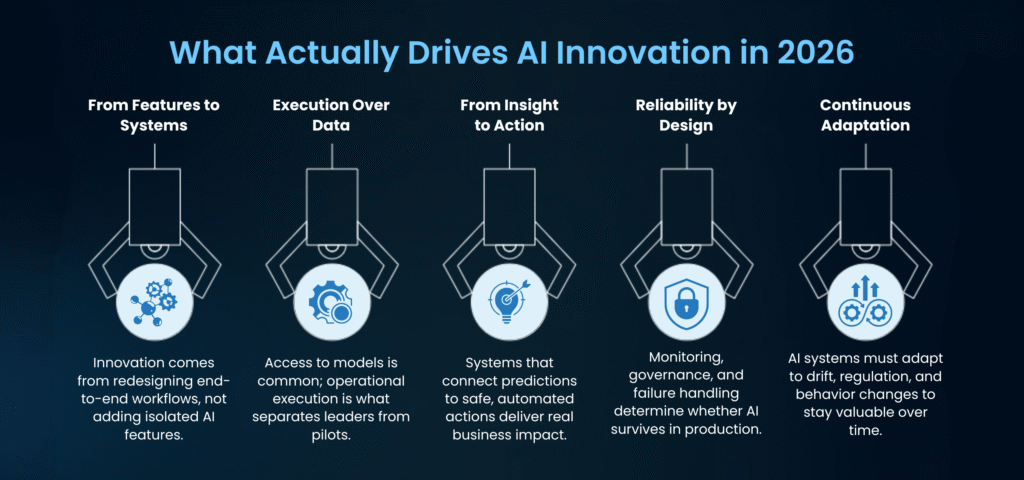
3. In 2026, AI Is Never “Finished”
There’s another shift shaping how AI drives innovation in 2026.
AI systems don’t age well if you ignore them.
User behavior changes. Data drifts. Regulations evolve. Models that worked six months ago quietly degrade.
That’s why innovation in 2026 treats AI as a continuous capability, not a one-time build.
Modern AI software development services are built around:
- Ongoing retraining to handle data drift
- Modular architectures that allow safe upgrades
- Monitoring systems for performance, bias, and reliability
Netflix is a classic example. Its personalization systems update constantly based on real-time viewing behavior, seasonal trends, and content availability. Netflix has publicly estimated that personalization contributes over $1 billion annually in retained revenue, not because of a single model, but because the system keeps learning.
In 2026, launching AI is easy.
Keeping AI useful is the hard part.
Final Thought
AI innovation isn’t experimental anymore.
It’s infrastructural.
Companies that treat AI as a feature struggle to scale. Companies that treat it as a system capability; engineered, governed, and continuously improved; move ahead.
That’s why AI software development services are becoming central to innovation strategies. They bridge the gap between intelligence and reality.
In 2026, innovation doesn’t belong to the companies with the smartest models.
It belongs to the ones who know how to build around them.
Ready to Build AI That Actually Innovates?
If you’re done with pilots and want AI that works in real products and operations, we design AI software development services focused on scalability, reliability, and long-term impact.
Contact us to explore how your AI strategy can drive meaningful innovation in 2026, and keep delivering long after launch.
From strategy to delivery, we are here to make sure that your business endeavor succeeds.
Whether you’re launching a new product, scaling your operations, or solving a complex challenge Hoop Konsulting brings the expertise, agility, and commitment to turn your vision into reality. Let’s build something impactful, together.
Free up your time to focus on growing your business with cost effective AI solutions!