Explore how predictive staff scheduling in hospitals uses data-driven load models to improve patient outcomes, reduce burnout, and optimize workforce costs through real-world healthcare examples.
Introduction
Hospitals operate in environments where demand fluctuates hourly, patient acuity shifts rapidly, and workforce availability directly shapes care quality. Large health systems manage thousands of staffing decisions daily, where even a 2-3% mismatch can trigger delays, overtime, and safety risks. As systems scale, staffing decisions are shifting from intuition-driven rosters toward data-driven orchestration. Dynamic staff scheduling powered by predictive load models represents a structural upgrade rather than a tactical fix.
Predictive staff scheduling in hospitals combines historical patient inflow, real-time operational signals, and external variables to anticipate workload before it materializes. Instead of reacting to overcrowded emergency rooms or understaffed wards, hospitals proactively align staff capacity with expected demand, improving cost control, clinician well-being, and patient outcomes.
Across advanced healthcare systems, predictive models influence staffing decisions 3-14 days ahead while recalibrating hourly, creating continuously learning scheduling systems.
Contact us
Start Your Innovation Journey Here
Why Static Scheduling Breaks Down At Scale
Traditional hospital schedules assume stability, yet real-world operations rarely follow averages.
Seasonality, outbreaks, public holidays, weather volatility, and demographic shifts create nonlinear demand curves. Emergency departments experience volume swings of 25-40% within a single week, while ICUs face acuity-driven workload changes exceeding 50% even when census remains stable.
At a large academic medical center in Boston, nurse-to-patient ratios drifted outside safe thresholds nearly 18% of the time during peak flu seasons despite full schedule compliance. Internal reviews showed over 60% of deviations occurred during predictable surges. National utilization analyses also show winter emergency demand exceeding staffing assumptions by up to 30%.
Static schedules struggle because:
- Staffing decisions are locked weeks ahead
- All shifts are treated as equivalent despite acuity variation
- Near-miss staffing failures are rarely converted into learning signals
Dynamic scheduling reframes staffing as probabilistic forecasting rather than fixed allocation.
How Predictive Load Models Work In Hospitals
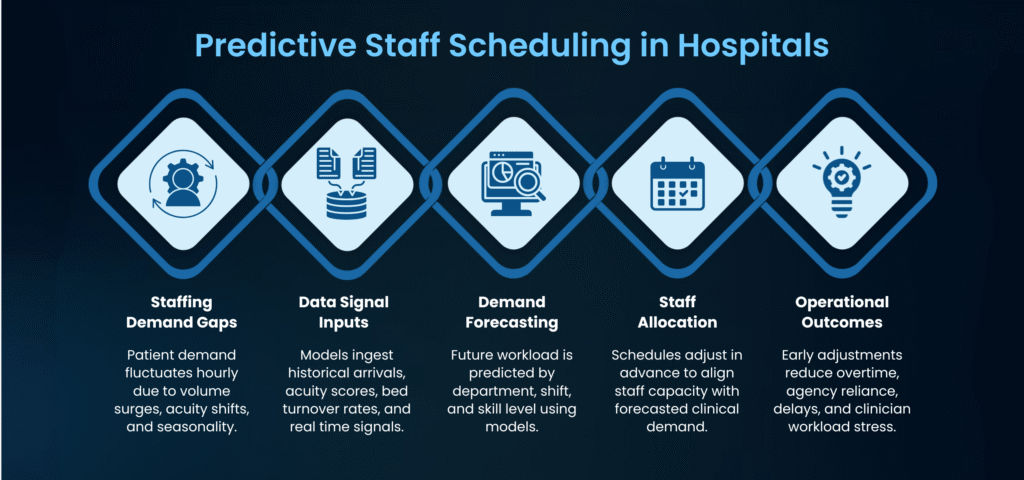
Predictive staff scheduling in hospitals relies on load models estimating future demand at department, shift, and skill levels.
These models ingest:
- Multi-year patient arrival data by hour and service line
- Admission-to-discharge flow patterns and bed turnover rates
- Case mix index and acuity scores
- External drivers such as temperature, air quality, and local events
- Real-time signals like ambulance diversions and occupancy
A large hospital group operating across London embedded predictive load models into emergency department staffing. Correlating weather patterns with historical trauma volumes enabled anticipation of heatwave and icy-condition spikes. Staffing adjustments made 48 hours earlier reduced average wait times by 22%, overtime costs by 14%, and left-without-being-seen rates by nearly 9% over twelve months.
At a teaching hospital in Oxford, incorporating real-time bed turnover data improved forecast accuracy by 17% and reduced last-minute agency staffing by 13%. These models narrow uncertainty rather than replace judgment.
Operational Truths Predictive Scheduling Reveals
- Volume alone is a weak signal
Raw patient count explains under 60% of staffing demand variance; acuity-adjusted models outperform volume-only forecasts by 25–35% in ICUs and recovery units.
- Fatigue compounds faster than shortages
Data from a large teaching hospital in Manchester showed medication error rates rising after three consecutive understaffed shifts, even when shortages stayed below 5%.
- Early signals outperform last-minute fixes
Interventions made 24–72 hours in advance reduce agency usage by 12–18% and overtime hours by 10–15%.
- Model drift is inevitable
Hospitals retraining models quarterly maintain forecast accuracy 15–20% higher than annual retraining.
Operational Impact And The Road Ahead
The impact of predictive staff scheduling in hospitals becomes visible when applied across functions.
In a multi-specialty hospital network along the West Coast, predictive scheduling expanded beyond nursing to radiology technicians and respiratory therapists. Aligning staffing with forecasted diagnostic demand and seasonal respiratory patterns reduced imaging backlogs by 19% and improved respiratory response times during asthma surges, without increasing headcount.
At a regional trauma center in the Midlands, predictive load models informed operating theatre staffing using historical surgery overrun data, surgeon-specific variability, and emergency admission probabilities. Synchronizing anesthesiologist availability reduced elective surgery cancellations by 11% and improved patient satisfaction across two audit cycles.
Workforce costs represent 55-60% of hospital operating expenses. Even a sustained 3-5% efficiency gain from predictive staff scheduling in hospitals can generate multimillion-pound annual savings through lower overtime and reduced agency reliance.
The discipline continues to evolve through:
- AI forecasting embedded into electronic health records
- Shift flexibility contracts tied to predictive demand bands
- Explainable AI models supporting regulatory scrutiny
- Cross-hospital load balancing
By 2028, over 65% of large hospitals are expected to rely on predictive models as the primary staffing driver.
From Scheduling To Strategic Capacity Advantage
Dynamic staff scheduling using predictive load models represents a structural shift in managing hospitals’ most constrained resource.
Predictive staff scheduling in hospitals aligns clinical capacity with patient reality, reduces burnout through smarter workload distribution, and improves financial discipline without compromising care quality.
Hospitals treating scheduling as a living system build resilience. Those delaying adoption absorb inefficiencies that compound quietly. The advantage lies in foresight, not reaction.
Contact Us
If your healthcare organization is exploring predictive staff scheduling in hospitals or modernizing workforce planning through advanced analytics, our team can help design, implement, and scale predictive load models tailored to your operational realities.
Contact us today to start the conversation.
From strategy to delivery, we are here to make sure that your business endeavor succeeds.
Whether you’re launching a new product, scaling your operations, or solving a complex challenge Hoop Konsulting brings the expertise, agility, and commitment to turn your vision into reality. Let’s build something impactful, together.
Free up your time to focus on growing your business with cost effective AI solutions!