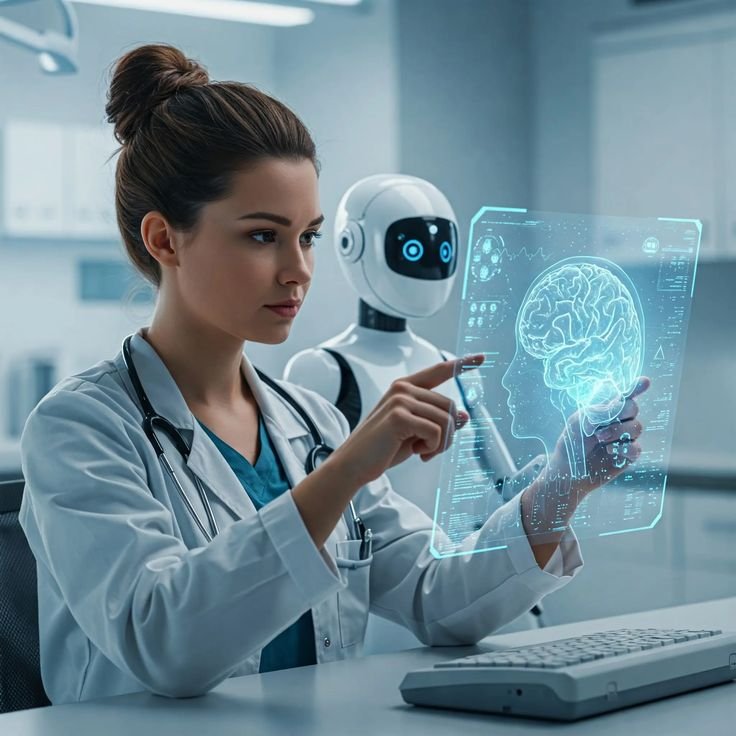
Healthcare AI delivers the most value when it augments clinical judgment instead of replacing it. Learn why second-brain systems are safer, more trusted, and more effective than autonomous clinical AI.
Introduction
Healthcare AI is often introduced with the most dangerous promise it can make.
Healthcare AI is often introduced with sweeping promises systems that can diagnose disease, recommend treatments, and even outperform doctors themselves.
The appeal is obvious. Healthcare systems are under strain. Clinician shortages are real. Administrative burden continues to grow. When AI models demonstrate high accuracy in imaging, triage, or diagnostics, it feels reasonable to ask why they should not take on greater responsibility.
But this framing misunderstands how medicine actually works.
Healthcare does not fail because doctors lack intelligence. It fails when information overwhelms judgment, context is fragmented across systems, and responsibility becomes unclear. In those conditions, replacing clinicians with AI does not reduce risk it amplifies it.
Healthcare AI fails when positioned as a second doctor.
It succeeds when designed as a second brain.
Contact us
Start Your Innovation Journey Here
Medicine Is Not Just a Prediction Problem
In many industries, prediction accuracy is the primary success metric. In healthcare, accuracy alone is insufficient.
Clinical decisions operate under constraints that models cannot fully absorb:
- Outcomes are often irreversible
- Evidence is probabilistic and incomplete
- Data is noisy, delayed, or contradictory
- Decisions unfold over days, months, or years
- Every action carries ethical, legal, and human accountability
A model can be right most of the time and still be unsafe when it is wrong. In medicine, a single confident mistake can permanently alter a patient’s life.
Consider a patient flagged by an AI system as “low risk” for sepsis based on vitals from the last four hours. The model is statistically correct. Yet a clinician notices subtle confusion, missed follow-ups, and a pattern of slow decline across multiple shifts signals scattered across notes, labs, and social history.
The data supports reassurance.
The context demands escalation.
This is why healthcare AI cannot be treated like AI in advertising, finance, or consumer software. In clinical settings, who decides matters as much as what is predicted.

What Doctors Do That Models Cannot
Clinical work extends far beyond diagnosis or treatment selection.
Doctors routinely:
- Synthesize incomplete and conflicting information
- Weigh competing risks under uncertainty
- Adapt guidelines to patient-specific constraints
- Incorporate patient preferences and social context
- Manage risk over time, not in isolated moments
Two patients can present with identical lab results and imaging findings. One may tolerate aggressive treatment. The other may lack caregiver support, face financial constraints, or prioritize quality of life over intervention.
The “correct” decision differs despite identical data.
Much of this work happens between the data points. It involves judgment shaped by experience, context, and responsibility.
Most importantly, doctors remain accountable. They explain decisions to patients and families, justify choices to peers and regulators, and carry responsibility when outcomes are poor even if the decision was reasonable at the time.
Models can recognize patterns.
They cannot absorb responsibility.
That distinction is structural, not philosophical.
Where Healthcare AI Actually Delivers Value
AI’s real advantage in healthcare is not judgment.
It is cognition at scale.
Modern clinical environments generate more information than any individual can reasonably process. Patient histories span years. Guidelines evolve continuously. Subtle signals of deterioration are often distributed across time.
This is where second-brain systems excel.
In practice, this looks like AI that summarizes years of fragmented patient records into a concise, shift-ready view highlighting only what has changed since the last encounter. It looks like systems that track longitudinal lab and vital trends, surfacing slow deterioration that would be invisible in a single snapshot.
During rounds or time-pressured decisions, AI can surface relevant clinical guidelines or prior decisions without recommending a course of action. In critical care settings, it can monitor patterns continuously and alert clinicians early without attempting to own the response.
These systems reduce cognitive load without transferring authority.
They help clinicians see more clearly, not decide for them.
The Risk of Treating AI as a Clinician
Problems arise when AI systems are framed as decision-makers rather than support tools.
Common failure modes include:
- Automation bias, where clinicians defer to AI recommendations
- Over-trust in probabilistic outputs presented with confidence
- Unclear responsibility when outcomes are poor
- Brittle behavior outside training data
- Regulatory and legal exposure due to ambiguous accountability
Consider a system that repeatedly recommends delaying escalation because risk scores remain below threshold. Over time, clinicians stop questioning the output. When deterioration finally occurs, no one is sure who made the decision—the model, the system, or the human who trusted it.
The most dangerous failure is not incorrect output.
It is misplaced authority.
When judgment is replaced rather than supported, risk increases.
The Second-Brain Model Explained
A second brain does not decide. It supports.
In healthcare, a second-brain system:
- Remembers more than any individual clinician
- Never gets fatigued
- Surfaces relevant information at the right moment
- Highlights patterns without prescribing action
Just as importantly, it does not:
- Diagnose autonomously
- Prescribe treatments independently
- Override clinical judgment
- Remove human accountability
A second doctor says, “Here is the diagnosis. Here is the treatment.”
A second brain says, “Here is everything you might need to decide and here is what changed since last time.”
This model aligns with how medicine actually functions: judgment informed by tools, not replaced by them.
Why This Framing Works Better
Designing AI as a second brain changes downstream outcomes.
Clinicians are more willing to adopt systems that respect their role. Automation bias is reduced. Regulatory approval becomes more straightforward. Responsibility remains clearly human. Patient trust is preserved.
Healthcare AI succeeds not because models are perfect, but because decision ownership remains intact.
The future of healthcare AI is not autonomous clinicians.
It is cognitive infrastructure that helps humans practice medicine more safely and effectively.
Contact Us
If you are building, deploying, or evaluating healthcare AI systems and want solutions that prioritize safety, adoption, and accountability, we can help.
Contact us to discuss how augmentation-first AI systems can be designed to support real clinical workflows without introducing unnecessary risk.
From strategy to delivery, we are here to make sure that your business endeavor succeeds.
Whether you’re launching a new product, scaling your operations, or solving a complex challenge Hoop Konsulting brings the expertise, agility, and commitment to turn your vision into reality. Let’s build something impactful, together.
Free up your time to focus on growing your business with cost effective AI solutions!