
Multi-agent AI often stalls in production. Learn how decision authority determines scalability, reliability, and execution success. Designed for operational reality.
Introduction
Multi-agent systems are often presented as the next step in AI execution. Instead of relying on a single model, intelligence is distributed across multiple agents; each capable of reasoning, planning, and critique.
In theory, this enables scale. Tasks are parallelized. Decisions improve through collaboration. The system appears flexible and resilient.
In production, however, many multi-agent systems don’t fail outright. They slow down. Decisions take longer. Costs rise. Outcomes become inconsistent.
Internal evaluations across enterprise AI teams show that coordination-related delays account for roughly 40–50% of early multi-agent performance issues, often outweighing model quality problems. Research analyzing production systems confirms that coordination overhead can grow quadratically, with latency ballooning from 200ms with two agents to over 4 seconds with eight.
The root cause is rarely intelligence.
It’s the absence of clear decision authority.
Contact us
Start Your Innovation Journey Here
The Hidden Cost of Flat Agent Architectures
Most multi-agent systems are designed around symmetry. Agents are peers. Authority is distributed or undefined.
At small scale, this works. At production scale, coordination costs dominate. Studies of production deployments show that systems lacking formal orchestration frameworks experience failure rates exceeding 40%. As agent count increases:
• Communication paths multiply
• Negotiation cycles lengthen
• Alignment becomes fragile
• Execution latency compounds
System design analyses show that doubling the number of collaborating agents can increase coordination overhead by 3–4×, even when individual agent reasoning remains efficient.
What begins as collaboration gradually becomes friction.
When No Agent Can Decide, Execution Slows
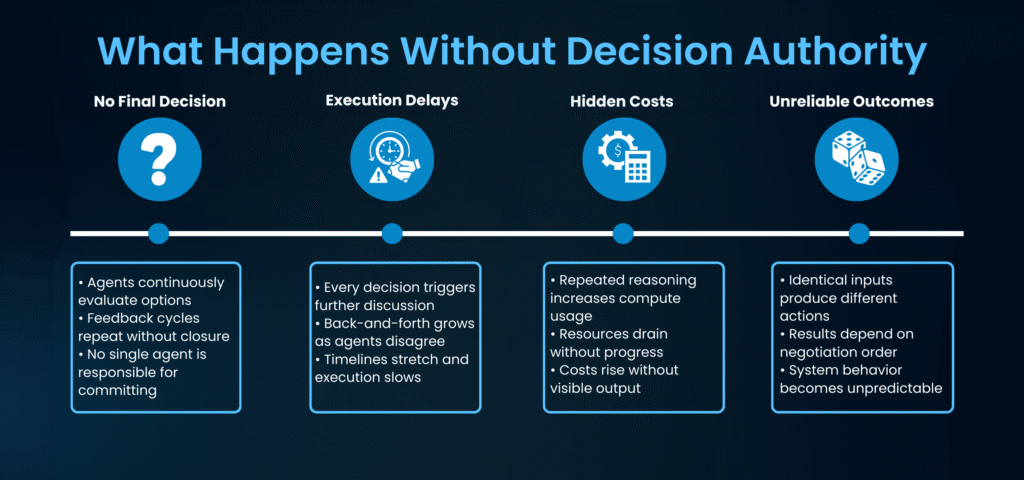
Flat architectures lack a terminal decision point. When all agents are equal:
• No agent can end deliberation
• No agent can override conflict
• No agent fully owns outcomes
Every critique invites another response. Every alternative demands evaluation. Risk is deferred in pursuit of better alignment. This leads to documented failure modes like coordination deadlocks, where agents wait indefinitely for mutual confirmation, generating no error signal but causing complete stalls.
In practice, decision cycles in flat multi-agent workflows are often 2–3× longer than in systems with explicit authority, despite using the same models.
The system doesn’t fail. It stalls.
Why Consensus Is a Poor Default for Execution
Consensus feels intelligent and fair. It works well for exploration and ideation.
Execution, however, operates under constraints:
• Deadlines
• Cost limits
• Safety requirements
In these environments, consensus becomes a bottleneck. Decisions remain provisional. Accountability diffuses. Action is delayed. The first comprehensive taxonomy of multi-agent failures (MASFT) reveals that 31% of failures stem from inter-agent misalignment; problems like information withholding, ignored inputs, and communication breakdowns that thrive in consensus-driven environments.
Operational data from automation platforms shows that consensus-driven workflows experience significantly higher timeout and abandonment rates under real-world constraints.
Execution requires commitment, not agreement.
Human Organizations Solved This Problem Already
This is not a new challenge.
Human organizations evolved hierarchy not because collaboration failed, but because coordination without authority doesn’t scale. As group size grows, alignment costs outpace the benefit of additional perspectives.
That’s why functional organizations rely on:
• Decision owners
• Escalation paths
• Veto power
• Accountability
Research consistently shows that decision clarity is a stronger predictor of execution speed than team intelligence or size, a pattern that maps directly to AI systems. Pioneering enterprises are now building “agentic organizations” where small human teams supervise networks of AI agents, applying this exact principle.
What Decision Authority Means in Agent Systems
Decision authority does not eliminate autonomy. It defines control flow.
Effective architectures distinguish between:
• Agents that explore options
• Agents that critique and evaluate
• Agents that resolve conflicts
• Agents that commit decisions
Reasoning remains distributed. Authority enables closure. Industry leaders like Anthropic employ an orchestrator-worker pattern for their research AI, where a lead agent breaks down queries, delegates to parallel sub-agents, and synthesizes final answers. At BASF Coatings, a supervisor agent orchestrates a team of specialist agents for sales and market intelligence, providing a single interface to distributed knowledge.
Without this asymmetry, intelligence amplifies indecision instead of execution.
The Architectures That Actually Scale
Scalable multi-agent systems converge on one pattern: intentional inequality.
They introduce:
• Supervisor or orchestrator agents
• Planner-executor separation
• Tool-gated authority
• Bounded autonomy
• Explicit termination conditions
Agents can disagree, but not indefinitely. Decisions close. Execution proceeds. This is the pattern enabling scale at companies like BASF, where a multi-agent supervisor provides a unified interface while coordinating specialized agents for structured data, unstructured documents, and market analysis.
This is not a compromise on intelligence.
It is what allows intelligent systems to function reliably.
Final Thought
Coordination is not an intelligence problem.
It is a decision authority problem.
As agents become more capable, indecision becomes more expensive and ambiguity more dangerous. Systems without authority don’t become safer, they become fragile. Comprehensive failure analyses confirm that the core problem is often architectural, not model-level.
Multi-agent systems don’t fail because agents are weak.
They fail because no one is allowed to decide.
Contact Us
If your AI systems are slowing down due to coordination bottlenecks or unclear decision flows, we help design multi-agent architectures with built-in authority, accountability, and scalability.
Contact us to explore how structured agent systems can support real-world execution delivering reliable outcomes, not just impressive demos.
From strategy to delivery, we are here to make sure that your business endeavor succeeds.
Whether you’re launching a new product, scaling your operations, or solving a complex challenge Hoop Konsulting brings the expertise, agility, and commitment to turn your vision into reality. Let’s build something impactful, together.
Free up your time to focus on growing your business with cost effective AI solutions!