
From MVP to unicorn, explore key app development lessons from San Francisco startups. Learn how App Development San Francisco teams build, scale, and succeed faster.
Introduction
San Francisco is where startup ideas are stress-tested, not romanticized. It’s the place where ambitious concepts either evolve fast or disappear quietly. Some of the world’s most iconic companies didn’t begin as polished products here; they began as rough MVPs built by lean teams working under relentless pressure from users, investors, and the market itself. What separated the winners from the rest wasn’t luck it was how they built.
At the heart of these success stories is App Development San Francisco style: an approach shaped by speed, experimentation, and an almost obsessive focus on real user behavior. Startups here don’t wait for perfection. They launch early, learn aggressively, and iterate faster than competitors can react. Every feature is tested, every assumption challenged, and every release treated as a data point not a final answer.
For founders and product teams today, understanding how San Francisco startups build apps is less about copying trends and more about adopting a mindset built for scale, survival, and long-term impact.
Contact us
Start Your Innovation Journey Here
Why San Francisco Sets the Global Standard for App Development
What makes App Development San Francisco different from anywhere else in the world?
It’s not just access to capital or elite engineers. It’s mindset.
San Francisco startups treat apps as living systems, not finished products. Launching an MVP is not the end goal it’s the beginning of a continuous feedback loop powered by users, data, and rapid experimentation.
Interesting fact:
More than 60% of successful San Francisco startups ship their MVP within 90 days, prioritizing speed to market over feature completeness.
This culture of velocity is one of the biggest competitive advantages in modern app development.
How Universities Are Reframing AI’s Role
Leading universities are not using AI to replace academic judgment. They are repositioning it earlier in the feedback pipeline. Instead of making evaluative decisions, AI is used to:
- Surface recurring misconceptions across cohorts
- Draft formative, rubric-aligned feedback
- Flag reasoning gaps and weak argumentation
- Highlight submissions that require closer faculty attention
AI prepares insight. Faculty retain authority. This distinction is critical. For example, writing programs at institutions like the University of Michigan deploy AI to analyze early drafts against specific rubrics, providing students with immediate practice and freeing instructors to focus on nuanced argument development during class. AI operates before human judgment, not instead of it. This allows scale without transferring academic responsibility.
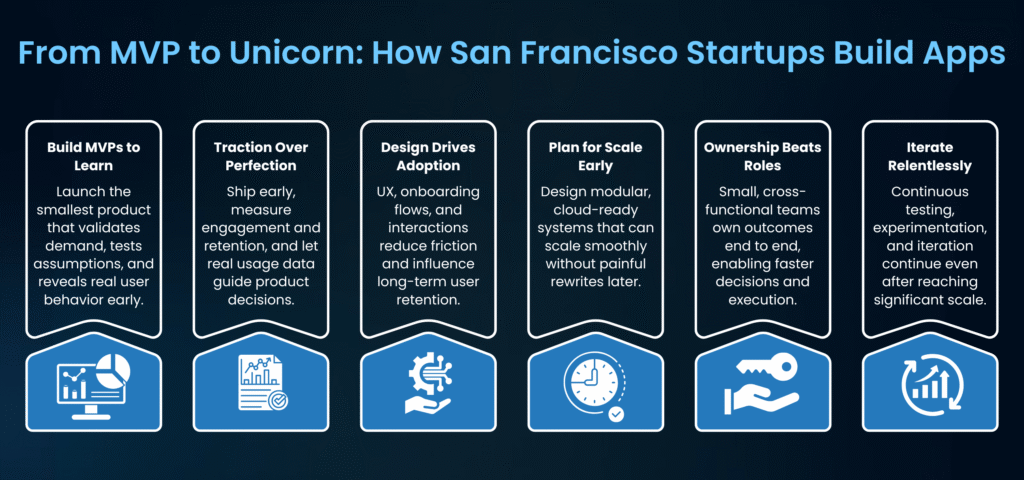
Lesson 1: MVPs Are Built to Learn, Not to Impress
In San Francisco, an MVP isn’t a “mini version” of the final product. It’s a learning machine.
Startups focus on:
- One core problem
- One primary user persona
- One clear success metric
Companies like Airbnb and Dropbox didn’t start with complex platforms. Their MVPs validated demand first, then evolved through real-world usage.
App Development San Francisco teams often ask:
“What’s the smallest product we can build to prove this is worth solving?”
This mindset reduces waste, speeds up iteration, and prevents overengineering.
Lesson 2: Product-Market Fit Beats Perfect Code
San Francisco startups don’t chase perfection early on. They chase traction.
Early stage app development prioritizes:
- User engagement
- Retention
- Behavioral data
- Feedback velocity
Engineering decisions are guided by usage data not assumptions.
Insight:
Many unicorns rewrote their core architecture after achieving product-market fit. They optimized after validation, not before.
This approach defines modern App Development San Francisco practices: ship → measure → adapt.
Lesson 3: Design Is Strategy, Not Decoration
In San Francisco, design isn’t just about UI it’s about decision-making.
Top startups invest heavily in:
- UX research
- Onboarding flows
- Micro-interactions
- Behavioral nudges
A smoother user journey often outperforms feature-heavy apps.
Example:
Slack’s early success came less from technical novelty and more from intuitive design that reduced friction in team communication.
In App Development San Francisco, design and engineering work side by side from day one.
Lesson 4: Scalability Is Planned Earlier Than You Think
While MVPs are lightweight, San Francisco startups still design with scale in mind.
This means:
- Modular architecture
- Cloud-native infrastructure
- API-first development
- Automation from early stages
The goal isn’t to overbuild it’s to avoid painful rewrites when growth hits.
Insight:
Many San Francisco unicorns plan for 10x growth scenarios while still in MVP stage, even if they don’t implement them immediately.
That foresight is a hallmark of mature App Development San Francisco teams.
Lesson 5: Teams Are Built Around Ownership, Not Roles
San Francisco startups favor small, autonomous teams with end-to-end ownership.
Instead of rigid roles, teams are structured around:
- Outcomes
- Features
- User journeys
Developers understand business impact. Designers understand metrics. Product managers understand technical tradeoffs.
This cross-functional approach accelerates decision-making and reduces handoffs critical for fast-paced App Development San Francisco environments.
Lesson 6: Iteration Never Stops—Even at Unicorn Scale
Becoming a unicorn doesn’t mean slowing down.
San Francisco startups continue to:
- A/B test features
- Ship weekly updates
- Kill underperforming ideas
- Rebuild workflows when needed
Interesting fact:
Top San Francisco apps run hundreds of experiments per year, even after reaching massive scale.
Iteration is cultural, not optional.
What Founders Can Learn from San Francisco App Development
To summarize, the biggest lessons from App Development San Francisco startups are:
- Speed beats perfection
- MVPs are tools for learning
- Design drives adoption
- Data guides decisions
- Scalability is intentional
- Iteration is continuous
Whether you’re building your first app or scaling an existing product, these principles can dramatically improve your chances of success.
Final Thought
San Francisco startups don’t succeed because they have more resources they succeed because they make better product decisions, faster.
If you adopt the mindset behind App Development San Francisco, you’re not just building an app you’re building a system designed to evolve, scale, and win.
Ready to explore how AI can scale quality feedback at your institution?
Looking to apply App Development San Francisco principles to your own product?
Contact us today to build scalable, high impact apps designed for growth from MVP to market leader.
From strategy to delivery, we are here to make sure that your business endeavor succeeds.
Whether you’re launching a new product, scaling your operations, or solving a complex challenge Hoop Konsulting brings the expertise, agility, and commitment to turn your vision into reality. Let’s build something impactful, together.
Free up your time to focus on growing your business with cost effective AI solutions!