
AI success doesn’t come from bold strategies alone. Learn why Enterprise AI Infrastructure is the real foundation behind scalable, secure, and competitive AI-driven organizations.
Introduction: The Invisible Shift Nobody Saw Coming
For decades, technology played a supporting role in enterprise strategy. Cloud enabled scale. Data enabled insight. Software enabled efficiency. Then AI arrived, and suddenly organizations began treating the technology itself as the strategy.
“We need AI.”
“We need LLMs.”
“We need agents.”
But very few leaders could clearly answer why.
Here’s the quiet shift reshaping the next decade of enterprise competition: AI is not the strategy. AI is the infrastructure layer on which all future strategies will be built.
Just as digital strategy eventually became impossible without cloud, modern enterprise strategy will soon be impossible without mature Enterprise AI Infrastructure. Companies making decisions in reverse starting with tools and vision instead of foundations are already paying the price.
Contact us
Start Your Innovation Journey Here
The Strategic Mistake Almost Every Enterprise Is Making
Saying “AI is our strategy” is like a company in 2005 saying “the internet is our strategy.” It sounds visionary, but it actually signals confusion.
The common mistakes look familiar:
- Leaders treat AI itself as the vision
- Teams invest in models instead of systems
- Organizations start with tools, not workflows
The consequences are predictable:
- Shallow pilot projects that never scale
- Rising costs without measurable ROI
- Misalignment between executive ambition and engineering reality
- No compounding advantage over time
Without Enterprise AI Infrastructure, AI initiatives remain isolated experiments rather than durable capabilities.
What AI Actually Is: The New Infrastructure Layer
AI is not a feature bolted onto existing systems. It is a new operating layer of the enterprise just as fundamental as cloud, data platforms, and networking.
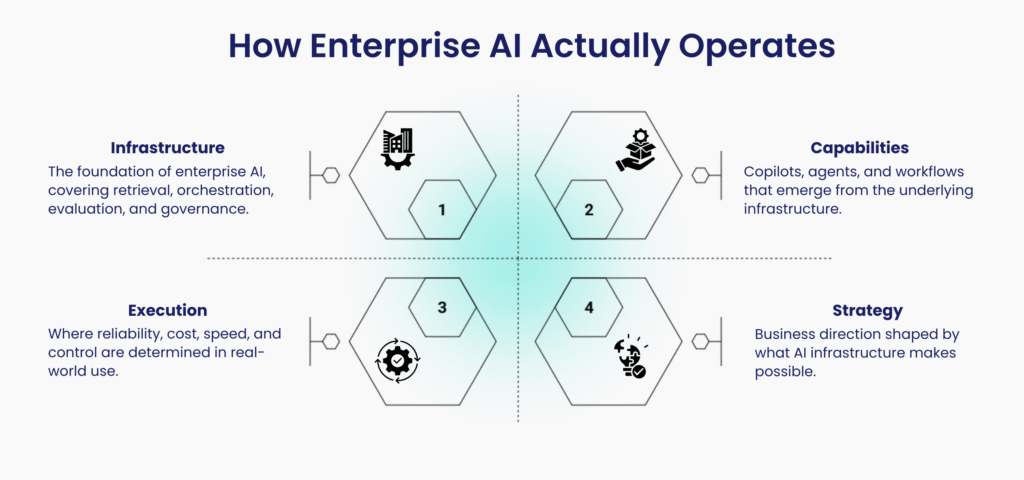
Enterprise AI operates across three dependent layers:
- AI as Infrastructure (Foundation)
This is the invisible layer that determines everything:
- Retrieval pipelines and embeddings
- Model routing and orchestration
- Observability and evaluation systems
- Safety, governance, and compliance guardrails
This foundation defines cost, reliability, speed, and trust. Without it, nothing above works consistently.
- AI as Capability (Middle Layer)
This is what the business sees:
- Copilots and assistants
- Automated workflows
- Agents and decision support
These capabilities inherit the strengths and weaknesses of the Enterprise AI Infrastructure beneath them.
- AI as Strategy (Top Layer)
This is where leadership wants to begin:
- New operating models
- Industry-specific innovation
- AI-driven business models
But strategy cannot stand without infrastructure below it.
Why Infrastructure Determines the Winners
Strategy without infrastructure is just a PowerPoint deck.
Enterprise AI Infrastructure shapes outcomes in four critical ways:
- Cost: Optimized infrastructure reduces LLM spend by 60–80%
- Speed: AI-native organizations ship in weeks, not quarters
- Reliability: Trust comes from SLAs, observability, and governance
- Performance: The same model performs radically differently based on retrieval, routing, and context quality
The winners won’t have better models. They’ll have better systems.
The AI Infrastructure First Model (AIFM)
- Pillar 1: Define Workflows, Not Models
Stop asking “Which model should we use?”
Start asking “Which workflow are we transforming?”
Model choice should be the final decision, not the first.
- Pillar 2: Assess Infrastructure Maturity Honestly
Evaluate readiness across:
- Data quality
- Retrieval and routing
- Observability and evaluation
- Governance and CI/CD
Overestimating maturity leads directly to failure.
- Pillar 3: Invest in Reusable AI Primitives
Build reusable components, not one-off features:
- Ingestion pipelines
- RAG templates
- Agent orchestrators
- Safety and evaluation layers
This turns future AI development into assembly, not reinvention.
- Pillar 4: Align Strategy With Infrastructure Reality
Separate initiatives into:
- What can be built today
- What can be built next quarter
- What should not be built yet
This discipline eliminates hype-driven failures.
The False Promise of “AI Strategy First”
AI-first strategies fail because:
- Strategy is abstract
- Infrastructure is immature
- Teams cannot operationalize vision
- Shadow AI increases risk
- Costs spiral out of control
Without Enterprise AI Infrastructure, ambition collapses under real-world constraints.
The Companies That Will Win the Next Decade
The winners will be organizations that:
- Treat AI infrastructure as shared, scalable foundation
- View AI as a system, not a tool
- Build compounding capability with every workflow
- Let strategy emerge after infrastructure maturity
In the AI era, strategy will increasingly be written bottom-up by infrastructure capabilities, not boardroom declarations.
Conclusion: AI Is Not the Strategy. AI Is the Foundation.
The enterprises that win the AI era won’t be the ones with the boldest visions.
They’ll be the ones with the strongest Enterprise AI Infrastructure.
Invest in foundations.
Build reusable systems.
Empower engineering.
Align ambition with capability.
Because in the end, strategy doesn’t lead infrastructure.
Infrastructure leads strategy. Always.
Contact Us
If your organization is exploring AI but struggling to move beyond pilots, we help enterprises design, build, and scale Enterprise AI Infrastructure that turns ambition into execution.
Contact us today to build AI systems that last.
From strategy to delivery, we are here to make sure that your business endeavor succeeds.
Whether you’re launching a new product, scaling your operations, or solving a complex challenge Hoop Konsulting brings the expertise, agility, and commitment to turn your vision into reality. Let’s build something impactful, together.
Free up your time to focus on growing your business with cost effective AI solutions!