
A detailed examination of enterprise AI development services in San Francisco, explaining what truly works in production through quantified outcomes, enterprise data, and real-world deployments.
Introduction
Enterprise AI has become a foundational operational capability. In San Francisco, artificial intelligence systems now operate inside payments processing, medical risk detection, fraud prevention, logistics forecasting, and enterprise support automation. These systems run continuously, influence financial outcomes directly, and must remain reliable under regulatory, technical, and economic pressure.
AI Development Services in San Francisco have evolved accordingly. The emphasis has shifted from experimentation to execution and from showcasing models to sustaining systems over time. McKinsey estimates that 55-60% of enterprises have launched AI pilots, yet fewer than 20% have scaled them across core business functions. Among those that do scale, operating margin improvements average 5-7 percentage points within two years. The differentiator is not model sophistication, but how AI is engineered for production environments.
Contact us
Start Your Innovation Journey Here
What Production Reality Forces AI Systems To Become
Once deployed, AI systems face constraints that reshape architecture and economics.
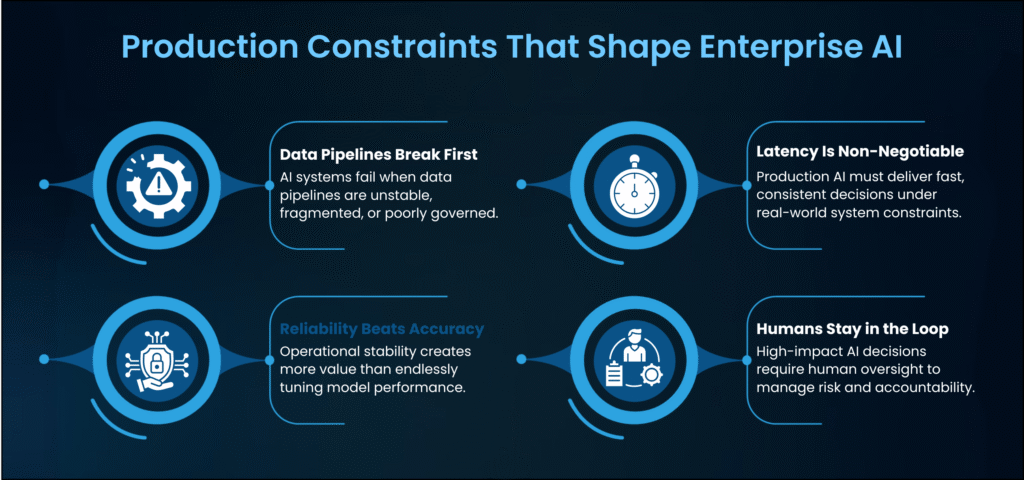
Enterprise environments typically enforce inference latency limits between 120 and 250 milliseconds, even when decisions rely on ensembles or multi-stage pipelines. Data ingestion systems process tens of millions to billions of records per day, often sourced from fragmented legacy platforms. Gartner reports that 87% of AI production failures originate from data pipeline issues, not from model logic.
A clear illustration comes from Stripe, whose machine learning systems evaluate transactions across more than 135 currencies and diverse merchant risk profiles. Internal disclosures suggest that improving false-positive rates by just 0.1% can unlock $20-30 million in annual recovered revenue. That improvement came from retraining cadence optimization, confidence scoring, and escalation logic, rather than from larger or more complex models.
These constraints shape how AI Development Services in San Francisco are delivered in practice.
- Data maturity defines ROI ceilings
Gartner estimates the average annual cost of poor data quality at $12.9 million per enterprise, while IBM finds that nearly 30% of enterprise data is unusable due to quality or accessibility issues.
- Reliability outperforms accuracy chasing
Netflix engineering teams have shown that chaos testing reduced AI production incidents by over 30%, compared to less than 5% improvement from accuracy-focused tuning.
- Human review remains essential
In financial services and healthcare, 60–70% of AI decisions include probabilistic thresholds that trigger manual review, reducing extreme-loss events by up to 45% according to internal risk audits.
As a result, AI Development Services in San Francisco increasingly prioritize monitoring, drift detection, observability, and governance as core components.
Why Strong Models Still Struggle In Live Environments
Model performance rarely survives real-world exposure unchanged.
A healthcare analytics company based in Cambridge deployed AI-driven clinical alerts across hospital systems serving over 3 million patients annually. Offline validation accuracy exceeded 90%, yet live precision dropped below 80% within three months due to demographic shifts, delayed records, and incomplete lab data. After implementing automated drift detection and quarterly retraining, alert relevance improved by 22%, while clinician override rates declined by 18%.
Research published by DeepMind reinforces this pattern. Longitudinal studies show that even high-performing models lose 5-10% effectiveness per year in non-stationary environments unless retrained and monitored continuously.
These realities explain why enterprises evaluating AI Development Services in San Francisco increasingly favor partners who understand system lifecycle management rather than standalone model delivery. During these transitions, organizations often work with Hoop Konsulting to align AI systems with compliance requirements, infrastructure limits, and internal decision ownership.
Investment data supports this shift:
- Global enterprise AI spending exceeded $154 billion in 2024, growing at a 27% CAGR
- North America accounts for roughly 45% of enterprise AI expenditure
- More than 70% of AI budgets are allocated to post-deployment activities such as monitoring, retraining, and governance
- Enterprises deploying AI across three or more workflows report 20-30% reductions in operating costs within 12-18 months
At this stage, AI Development Services in San Francisco are judged primarily on post-launch metrics such as uptime, latency stability, loss prevention, and sustained economic impact.
Where Enterprise AI Is Stabilizing
Enterprise AI is entering a phase defined by control, auditability, and accountability.
Organizations are adopting deterministic guardrails layered over probabilistic outputs, modular architectures with traceable decision paths, and centralized governance frameworks. Deloitte reports that companies with formal AI governance structures are 2.4× more likely to scale AI beyond pilot deployments.
Enterprise software leaders such as Salesforce now deploy AI across product portfolios using unified governance models, ensuring consistent policy enforcement across regions and regulatory environments.
The conclusion is clear. AI Development Services in San Francisco succeed when production readiness is treated as the primary design goal. Enterprise AI delivers lasting value only when built for real constraints, real users, and real consequences.
Contact Us
If your organization is looking to translate AI investment into durable operational outcomes, contact us to explore how a production-first approach to AI delivers results that hold up over time.
From strategy to delivery, we are here to make sure that your business endeavor succeeds.
Whether you’re launching a new product, scaling your operations, or solving a complex challenge Hoop Konsulting brings the expertise, agility, and commitment to turn your vision into reality. Let’s build something impactful, together.
Free up your time to focus on growing your business with cost effective AI solutions!